Technical Log
Blockchain: The End of Idealism and Survival as a Tool
Table of Contents
1. The Market Doesn't Lie
Recently, while Bitcoin and crypto markets have been trading sideways, real-world safe-haven assets like Gold and Silver are hitting all-time highs. This decoupling is telling.
Geopolitical Risk
Taiwan-China tensions, the Russia-Ukraine war, Venezuela, Iran, Greenland resource disputes — global uncertainty is at a peak.
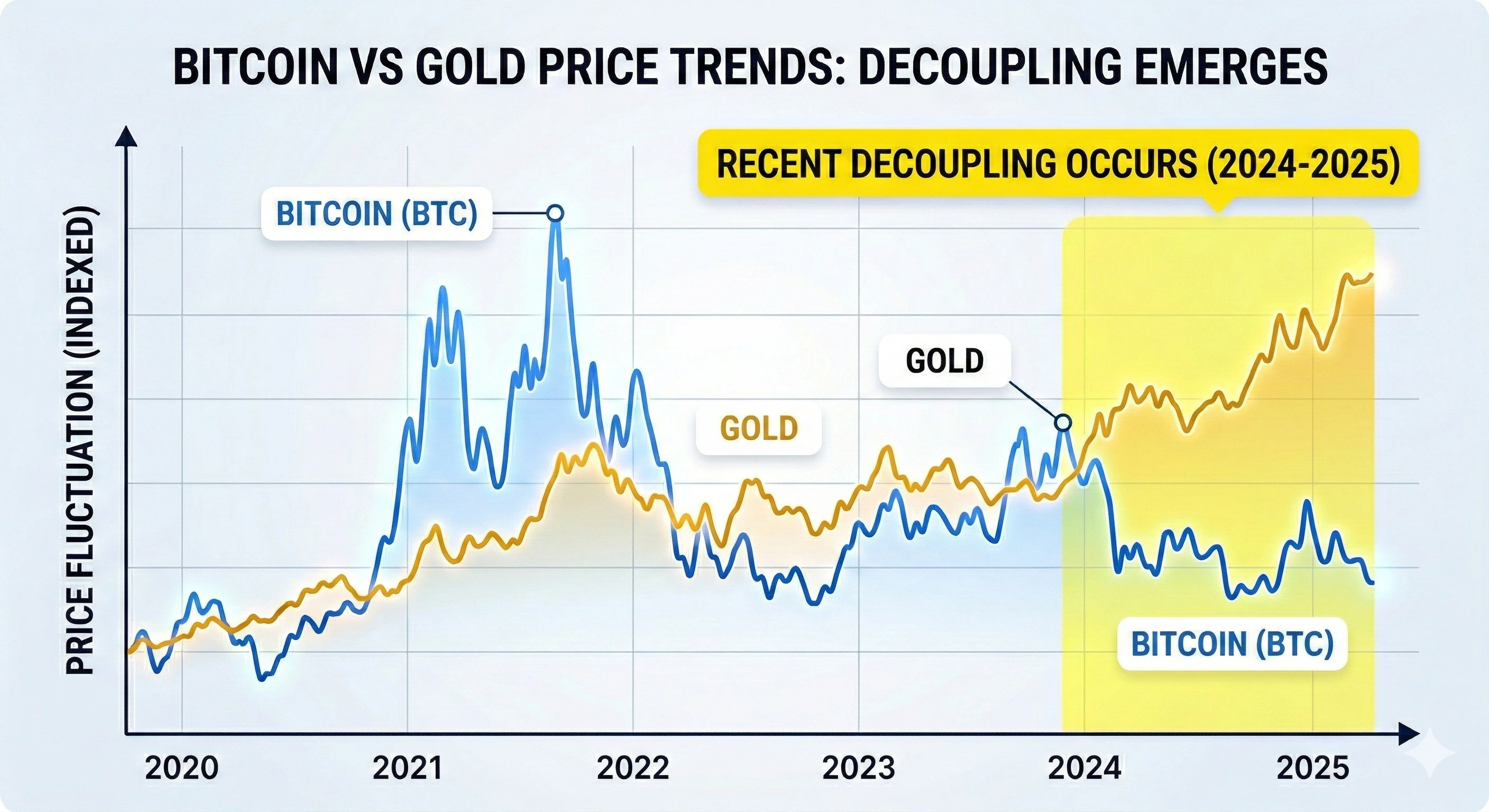
BTC vs Gold price trends showing the decoupling in 2024-2025
The "Digital Gold" Narrative Has Failed
"When war breaks out, Bitcoin moons" — that narrative is dead. In real crises, capital doesn't flee to unproven digital trust (Code). It returns to historically proven physical trust (Physical Assets).
Trust Collapse Triggers — By the Numbers
The past few years delivered a series of catastrophic failures that burned systemic risk into the public consciousness:
| Event | Type | Losses |
|---|---|---|
| FTX (Nov 2022) | Centralized moral hazard | ~$8B in customer funds |
| Terra/Luna (May 2022) | Algorithmic design failure | ~$40B market cap evaporated |
| Ronin Bridge (Mar 2022) | Bridge exploit | $625M |
| BNB Bridge (Oct 2022) | Bridge exploit | $570M |
| Wormhole (Feb 2022) | Bridge exploit | $321M |
| Nomad (Aug 2022) | Bridge exploit | $190M |
| Bybit (Feb 2025) | Exchange hot wallet exploit | ~$1.4B |
Bridge hacks alone exceeded $2.8B cumulatively since 2022. As Elliptic's co-founder noted: "Blockchain bridges have become the low-hanging fruit for cyber-criminals."
2. Is Decentralization an Illusion?
When you crack open the Layer 2 and Layer 3 solutions built to solve scalability, you find that they all sacrifice the philosophy of decentralization for performance.
The Compromise on Verification
The P2P principle of "every node verifies every piece of data" has been abandoned.
-
•
ZK Rollup: Replaces full verification with mathematical probability (polynomial proofs).
-
•
Sharding: Replaces full replication with random sampling for security.
Bottom line: Blockchain is no longer a revolutionary distributed network. It has compromised into a high-cost, high-performance database that guarantees T+0 settlement.
3. L2 Sequencer: Centralization in Disguise
The sequencer — the heart of Layer 2 — is essentially a single centralized server. Let's look at how Optimistic Rollups (Optimism, Arbitrum) actually work under the hood.
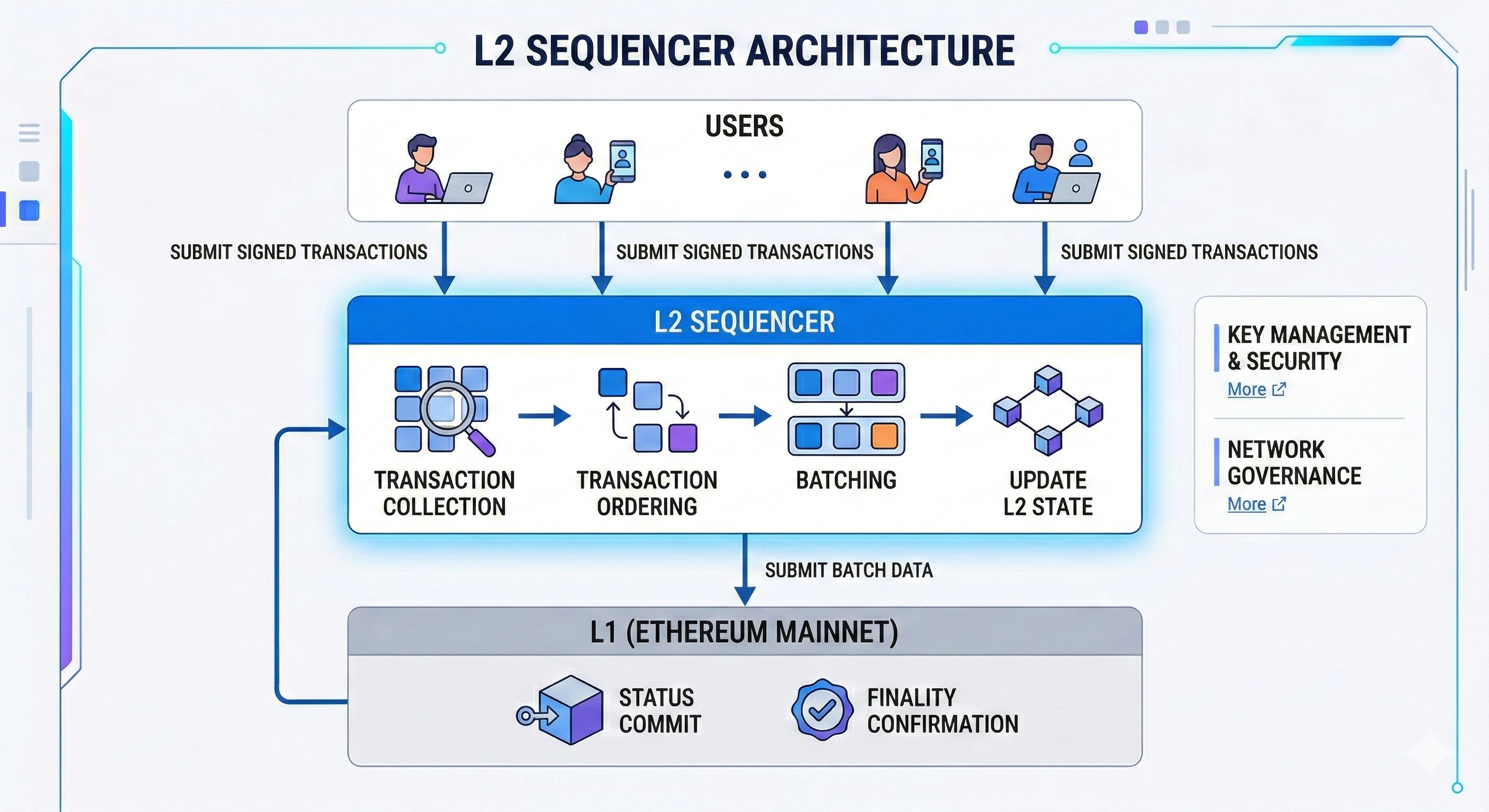
L2 Sequencer: a single operator controls transaction ordering, batching, and L1 submission
What's Wrong With This Picture?
-
•
SPOF: The sequencer is a single operator. If it goes down, the entire L2 halts.
-
•
MEV Extraction: The sequencer decides transaction ordering — it can front-run, back-run, or sandwich trades at will.
-
•
Censorship: A single operator can selectively exclude transactions, violating the core promise of permissionless access.
-
•
Revenue monopoly: Sequencer fees and MEV profits flow to one entity, not the network.
In plain engineering terms, the L2 sequencer is Kafka + Batch Worker with an Ethereum write-back. It skips consensus entirely for speed. This is not peer-to-peer — it's a centralized message queue with blockchain as a commit log.
4. T+2 vs T+0: The Settlement Cost Reality
The strongest argument for blockchain in finance isn't decentralization — it's settlement efficiency. Let's look at the numbers.
Traditional Finance: The Hidden Cost of Waiting
-
•
DTCC processed $3.0 quadrillion in securities in 2023, clearing ~214 million transactions daily.
-
•
Under T+2 settlement, over $5 billion was held in risk margin at any time just to manage counterparty default risk.
-
•
DTCC's multilateral netting reduces actual settlement amounts by ~98% — on a $3.51T trading day, only $80.3B needed final settlement.
-
•
After moving from T+2 to T+1, NSCC's Clearing Fund dropped 23% ($12.8B → $9.8B), saving billions in locked capital.
| Settlement Cycle | Counterparty Risk | Margin Required | Netting Benefit |
|---|---|---|---|
| T+2 | High (2-day exposure) | $12.8B+ (NSCC) | 98% reduction |
| T+1 | Medium (1-day exposure) | ~$9.8B (23% less) | Still available |
| T+0 (Blockchain) | Near zero (atomic) | Minimal | Lost (no window) |
The Catch: Netting vs Instant Settlement
T+0 eliminates counterparty risk but destroys the netting benefit. DTCC's netting currently reduces the $3.51T in daily trades down to $80.3B in actual settlement — a 98% reduction. Moving to real-time settlement would require every trade to settle individually, demanding far more liquidity.
This is why SIFMA concluded that "moving to T+0 would require fundamental and costly changes and actually increase risk." Blockchain's T+0 promise is real, but only makes economic sense for specific asset classes where netting is less critical.
5. The Pragmatic Pivot: Enterprise Blockchain
Moves by JP Morgan's Onyx and institutions like Shinhan Investment Corp show a pragmatic approach: discard the ideology, keep the technology.
Go-Quorum: Ethereum, Minus the Religion
Go-Quorum forks Ethereum (Geth) but replaces the slow PoW/PoS consensus with Raft/IBFT for instant finality, and adds PrivateFor for enterprise confidentiality.
IBFT Consensus Configuration (genesis.json)
{
  "config": {
    "chainId": 1337,
    "istanbul": {
      "epoch": 30000,
      "policy": 0,            // Round-robin block proposer
      "ceil2Nby3Block": 0,   // 2/3 majority required
      "blockperiodseconds": 2, // 2-second block time
      "requesttimeoutseconds": 4
    }
  },
  "alloc": { ... }
}
Private Transaction with PrivateFor
// Only Node A and Node B can see this transaction
// Other validators process it but cannot read the payload
const txHash = await web3quorum.priv.distributeRawTransaction({
  privateFrom: "nodeA_public_key",
  privateFor: ["nodeB_public_key"],  // Restricted visibility
  data: encodedContractCall
});

// Result: tx hash on public chain, payload only in
// private state of Node A and Node B| Aspect | Public Chain (Idealism) | Enterprise Chain (Pragmatism) |
|---|---|---|
| Consensus | PoW / PoS (slow, probabilistic) | Raft / IBFT (instant finality) |
| Privacy | Fully transparent | PrivateFor / Confidential Tx |
| Goal | Decentralized freedom | Cost reduction & settlement efficiency |
| Trust Model | Trustless (code is law) | Permissioned (institutional trust) |
| Block Time | ~12s (Ethereum) | ~2s (IBFT configurable) |
6. RWA: Where Blockchain Actually Works
If blockchain has found a genuine product-market fit anywhere, it's in Real-World Asset (RWA) tokenization — tokenizing government bonds, gold, and corporate debt to slash distribution and settlement costs.
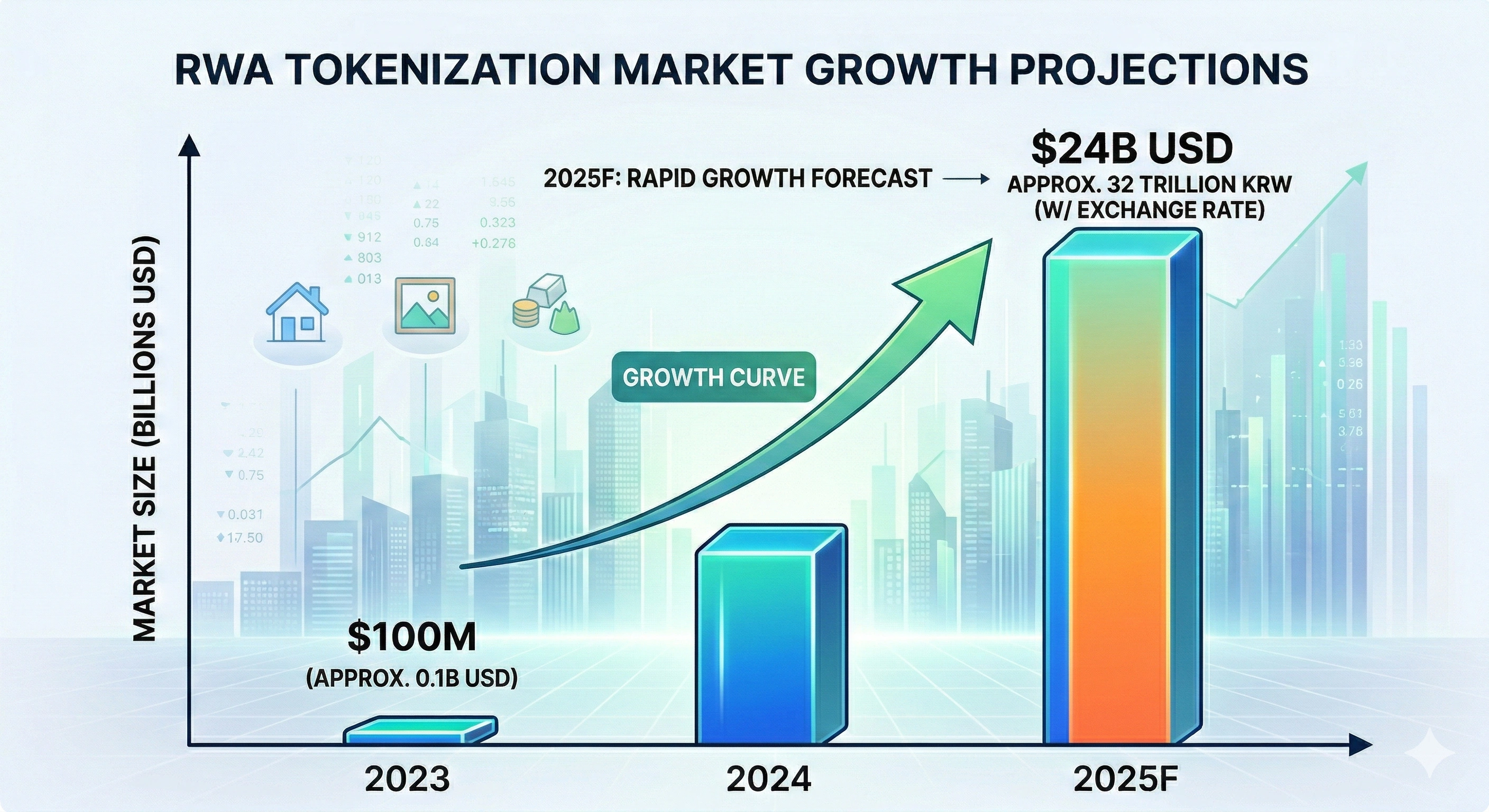
RWA tokenization market: from $100M to $24B in just two years
RWA Market by the Numbers
-
•
On-chain RWA market grew 308% over three years to ~$24B by mid-2025.
-
•
Tokenized U.S. Treasuries alone grew from $100M (Jan 2023) → $7.5B (Jun 2025) — a 7,400% expansion.
-
•
BlackRock's BUIDL fund: launched at $40M in March 2024, now $2.9B+ AUM with 40% market share in tokenized treasuries.
-
•
Over 200 active RWA projects with 800% TVL growth since 2023.
| RWA Segment | On-Chain Value (2025) | Key Player |
|---|---|---|
| Private Credit | ~$14B | Centrifuge, Maple |
| U.S. Treasuries | ~$8.7B | BlackRock BUIDL, Franklin Templeton |
| Commodities (Gold, etc.) | Growing | Paxos Gold, Tether Gold |
Forecast
McKinsey projects $2 trillion by 2030. Ripple/BCG forecast $18.9 trillion by 2033 (~53% CAGR). The direction is clear: blockchain will survive not as a payments network for the masses, but as backend infrastructure for institutional finance.
7. Conclusion
Blockchain should not be viewed as a blind "investment vehicle" or "ideological tool." It should be approached as an engineering tool that solves inefficiencies in financial systems.
-
1
The "digital gold" narrative failed under real geopolitical stress — capital returned to physical assets.
-
2
L2 solutions sacrificed decentralization for performance — the sequencer is just a centralized message queue.
-
3
T+0 settlement eliminates counterparty risk but destroys netting — it only makes sense for specific asset classes.
-
4
Enterprise chains like Go-Quorum proved that you can take the tech and leave the religion behind.
-
5
RWA tokenization at $24B+ and growing 300%+ per year is where blockchain found real product-market fit.
Technology only works on top of human desire and self-interest. The masses don't want decentralized freedom — they want a system that keeps their money safe and grows it fast.
Advertisement